
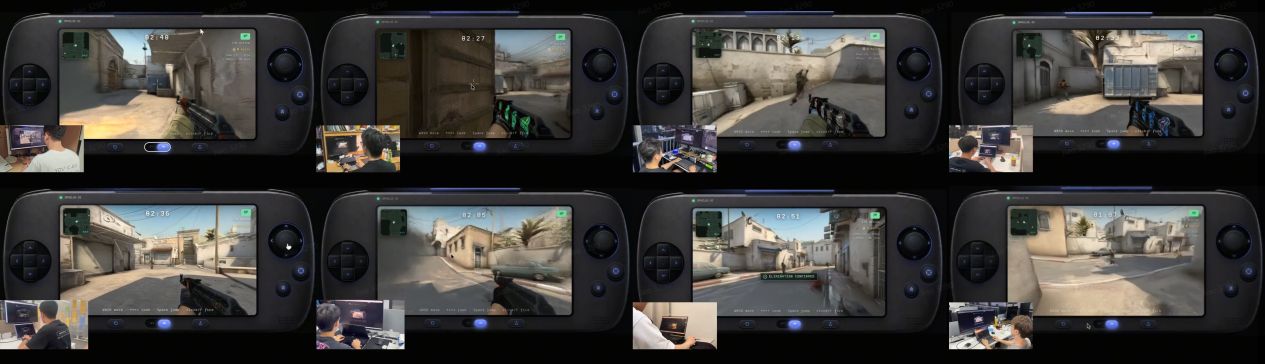
Ophilus introduces Khora, a scalable multiplayer world model built in collaboration with RhOS. Its public eight-player real-time demo is now open.
The public demo turns Khora’s scaling architecture into a live deathmatch that people can play today at ophilus.ai/khora.
Table of Contents
A World Model People Can Play Today
In the demo, multiple players enter the same generated environment and compete in real time. Each match includes fast first-person movement, structurally complex maps, live combat, a leaderboard, kill tracking and a post-match results panel.
Those mechanics put pressure on the model. It must track where players are, what they can see and how one player’s actions affect everyone else, even during fast movement, elevation changes and combat.
The current public demo provides direct, playable evidence of Khora’s scalability, while also making its real-time response, cross-player consistency, long-horizon stability and gameplay visible. Khora has already received positive feedback on X following a post from @OphilusAI.
Why Multiplayer Changes the Problem
A world model predicts the next frame from a player’s action. Move left, and it generates the view to the left. Turn around, and it imagines what should appear behind you. Most existing experiences assume one player, one viewpoint and one generated future.
With multiple players, every view must agree. If one player opens a door, everyone else must see that door open. If two people approach each other, their positions and movements must match from both perspectives. The world must remain consistent across every player’s view.
Khora treats every participant as an active entity whose actions update a shared world, then generates each player’s next view from that common state.
How Multiplayer World Models Got Here
Solaris, presented by a research team including Saining Xie, demonstrated how two participants could interact with a jointly generated world, providing an important theoretical and practical foundation for subsequent multiplayer world-model research. Its companion project, SolarisEngine, introduced an open framework for collecting synchronized multiplayer observations and ground-truth actions in Minecraft. Its public demonstrations support two agents, while real-time inference and spatio-temporal consistency remain limitations.
Other projects advanced different parts of the problem. Agora-1 demonstrated real-time generation, although its public examples focused on relatively simple, texture-sparse environments. MIRA pushed scene quality further but continued to support a limited number of simultaneous agents.
Together, these projects made multiplayer generation tangible but left scalability as an open bottleneck, especially when real-time performance, cross-view consistency, complex environments, long-horizon interaction and multiple players must work together. Khora focuses on that bottleneck.
One Shared State, More Players
Pairwise communication becomes costly as players are added. If every view communicates with every other view, cross-agent interaction grows at O(n^2). For example, 1,024 agents create more than one million pairwise relationships.
Khora uses STBoard (Spatio-Temporal Board), a shared state model that every agent can update and read. When an agent acts, a state transition model updates the board. Each agent then predicts its next frame from its local conditions and the shared state.
Because each view can be generated independently after reading from STBoard, complexity grows linearly at O(n). Ophilus and RhOS describe it as the first scalable multi-agent world model to achieve linear-time complexity. The architecture does not hard-code a player limit; adding an agent requires another generated view rather than a new set of pairwise exchanges.
Next: Generalization Across Maps and Play Styles
Ophilus will continue its collaboration with RhOS on a major Khora update scheduled for mid-August. The update will validate Khora’s generalization more broadly across additional generated maps, visual styles and forms of gameplay.
Ophilus is a new brand built on Yahaha, a platform for creating and sharing multiplayer 3D worlds. Ophilus turns synchronized multiplayer interaction into training data and evaluation signals, helping world models learn how shared worlds behave and evolve. The goal is to make multiplayer world models fun to play, deliver high-quality visuals in real time as more players join, and generalize across new maps and gameplay experiences. Khora is a first step toward that goal.
Beyond games, scalable shared-world models could support multi-agent training, embodied AI, shared virtual spaces, and interactive films and stories.
Try Khora
Enter the public eight-player demo at ophilus.ai/khora. Follow @OphilusAI and @RhOS_AI on X for gameplay clips and updates on the next release.